Nashville Slave Markets as Remembered by J.C. Napier
From the May 6, 1934, Nashville Banner
By M.B. Morton
It is an interesting fact that most of the slave markets in Nashville in the “days before the war” were located on or near the present site of the colored Y.M.C.A. Building, once known as the Duncan Hotel, at the corner of Cedar Street [today’s MLK Jr. Boulevard, previously Charlotte Avenue] and Fourth Avenue—near the cultural and business center of Negro activities in Nashville. It is also a notable fact that after the War Between the States the old Freedman’s Bank was located at the northwest corner of the present colored Y.M.C.A. Building, facing on Cedar Street.
Several years ago, as a contribution to the history of Nashville, the writer of this article wrote for The Banner a story of the old slave markets, gathered from a number of old citizens, most of whom are now dead. Now this story is supplemented by the recollections of J.C. Napier, Negro lawyer and financier, who was born in 1845 and consequently was a boy some sixteen years old when the old regime passed away. When asked for an interview he said:
“At that time most of the activities of the city centered about the area bounded by Cedar and Church Streets and Second and Seventh Avenues. Beyond these limits there was very little of Nashville.
“In this area there were three slave sale yards. One was located at what is now Nos. 405, 407, 409, and 411 Cedar Street, a part of the colored Y.M.C.A. Building. Another was located on the north side of Cedar Street between Fourth Avenue and the Square. This site is now Nos. 316, 318, and 320 Cedar Street. Another was on Fourth Avenue, about fifty-foot front, running north towards Deaderick Street from the building now occupied by the Anderson Fish and Oyster Co.
“My recollection is that there was still another on Broadway, but just where its location was I do not know. I remember the name of only one man who operated these slave sale yards. His name was William Boyd, generally known as Bill Boyd. He was reported to be a very kindly disposed man, but he finally committed suicide in his rooms at the corner of Church Street and Sixth Avenue.
“On one occasion I saw a number of slaves chained in line and being marched west on Cedar Street.
“In 1858 in Nashville Post Office was located at the southeast corner of Cedar Street and Fourth Avenue. It also occupied about two store-rooms on the south side of Cedar, across the street from the Veranda Hotel and the Carter Stagecoach offices.”
There was as Mr. Napier says a slave market on Broadway near the steamboat landing. One also was located on part of the present side of the Maxwell House, on Fourth Avenue, a short distance from Church Street.
(Newspapers.com)
Editor’s note: In a 1927 obituary for Bertha Lusky, who died at age 107, M.B. Morton wrote: “The old slave market on Broad street between Market and Cherry streets (now Second and Fourth avenues) was often vividly recalled by Mrs. Lusky. She would tell of the sights that accompanied a sale of Negroes, and of how the little boys and girls would weep bitter tears at their separation.” (Nashville Banner, Nov. 16, 1927)
For more on this topic, get our Slavery in Nashville Sampler Set and listen to our podcast Episode 11: Slavery, Runaways, Fancy Girls.
The Nashville slave market historical marker shown here was dedicated in December 2018. The marker was installed by the Tennessee Historical Commission based on a proposal written by Tennessee State University history professor Dr. Learotha Williams with the help of students and community members, according to a Tennessean article. The first mention of a marker may have been 110 years earlier, when the Nashville Banner called for markers to be placed on historic sites throughout the city, including the slave markets, in an Oct. 13, 1908, editorial.
The 1856 advertisement for slave traders Boyd & Lyles (featured in Dispatch No. 56) was found via the dust jacket of Paul Clements’ book Tell Them We Were Rising.
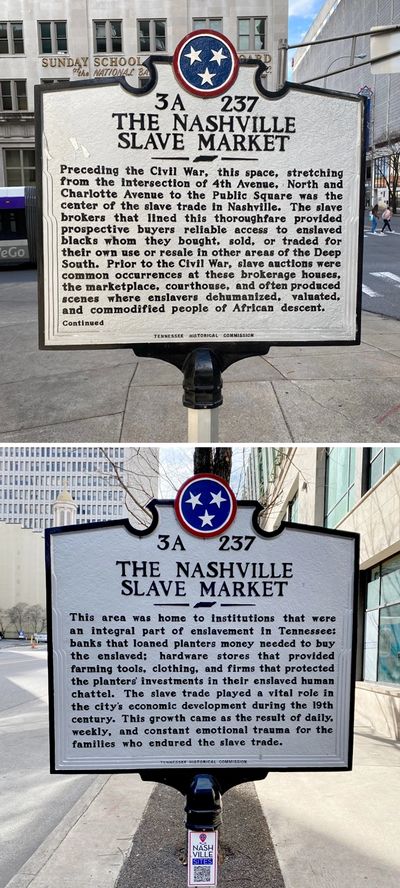
This historical marker is located at Fourth Avenue North and MLK Jr. Boulevard (Charlotte Avenue).