‘Holiday of World Fashions’ Theme of Fisk Show
From the April 11, 1962, Nashville Banner
By Robert Churchwell
A leisurely look at what is right in attire on smart thoroughfares everywhere will be the theme highlighted by the 11th annual “Holiday of World Fashions” at Fisk University April 23.
The presentation will benefit the local chapter of the United Negro College Fund. It will be staged with a cast of 40 Fisk students in the university Memorial Chapel at 8:30 p.m.
In addition to high fashions in street and formal wear, there will be featured scenes of costumes from various countries. Included will be such titles as “Global Flight,” an international airport setting; “Small World,” featuring children; “Transcontinental Boulevard,” street wear in the afternoon; and finale, an “International Ball,” presenting the sweethearts and debutants of the campus in formal attire.
Student leaders of the presentation are Florence Bond, Brownsville, chairman of patrons; Ada Williams, St. Louis, chairman of models; Jean Colston, Knoxville, chairman of publicity, Carmen Alexander, Atlanta, fashion show co-chairman, Casma Gregory, Cleveland, Ohio, program chairman; Gretchen Brown, New York City; Diane Bradshaw, Chattanooga fashion show co-chairman, Minnie Miles, Houston, and Sherry Hicks, Inkster, Mich., art chairman; Charlene Long, Philadelphia, decorations chairman; Brenda Bilbrye, Alcoa, Tenn., and Zee Clark McBain, Middletown, Ohio, in charge of children.
Mrs. Margaret Simms, resident counsellor of Scribner Hall, is director of the presentation.
(Tennessee State Library and Archives)
Editor’s note: Regarding the Rich Schwartz advertisement on this page, learn more about the store and downtown shopping in Nashville Retrospect Podcast Episode 03.
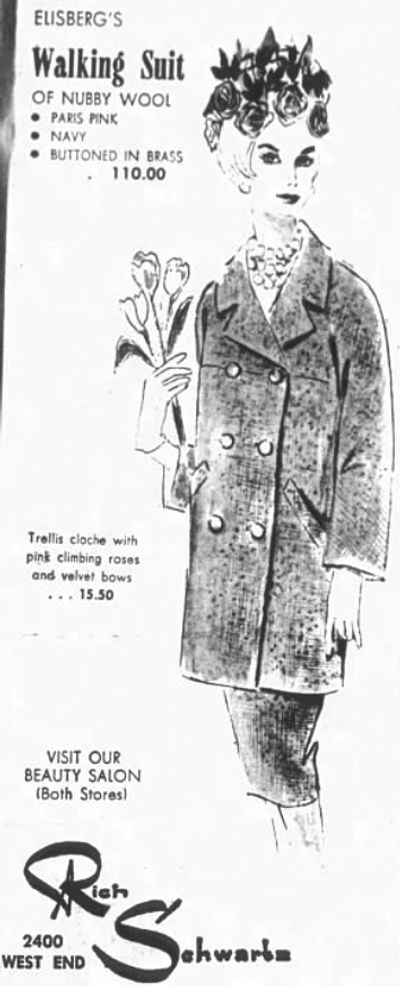
This ad appeared in the April 11, 1962, Nashville Banner. See note below. (Newspapers .com)
2nd Policeman Haircut Victim
From the April 17, 1973, Nashville Banner
A second Metro policeman has been suspended for one day for violating a hair regulation, but he said he felt his hair “doesn’t affect my ability to do my job.”
Patrolman Mike Greenfield drew a suspension over the weekend after he refused to obey an order to have his hair tapered in the back.
A disciplinary hearing has been scheduled for April 24.
The action against Greenfield was taken by Lt. Tommy Hayes who gave the suspension when the officer reported for duty Sunday with his hair blocked off in the back. A police department regulation revised “last April or May” specifies that officers cannot wear their hair blocked, according to Police Maj. Joe Casey.
“The length of the hair was not the question,” said Casey. “It was in violation of Order 68-3.”
Last Friday similar action was taken against patrolman Ricky D. Willis by Sgt. Larry Fagan. After his suspension, Willis said he and Fagan have had personal differences before. He also claimed that this hair was shorter than Fagan’s.
Greenfield, who said yesterday he feels his hair “doesn’t offend anybody,” explained that he believes his hair appears very neat and added, “I have always worn it in this manner and have never had any trouble.” He added:
“In my case, and in some others, blocking the hair looks good and my hair isn’t long at all. I think on some people it looks just as bad when the hair is tapered and then it grows out into a point in the back.”
Greenfield, who said he has had no personal problems with any of his superior officers, said if he felt that he was “disgracing my uniform I would not hesitate to make a change but I don’t think I am.”
“I could understand if when I put on the cap the hair bulged out on the sides or came down over my ears. I think that would definitely look bad on the uniform,” the officer added.
Attorney Joe P. Binkley, Sr., president of the police department’s independent Police Union, protested Willis’ suspension in a letter to Police Chief Hugh Mott, and called the action “arbitrary, capricious and without any merit whatsoever.”
Police department sources say several officers in the police department are “upset” over sudden restrictions on the way an officer wears his hair.
(Newspapers.com)

This ad appeared in the April 17, 1973, Tennessean. (Newspapers .com)
Poison Spray Ends Snaky Invasion
From the April 10, 1971, Nashville Banner
By Rick Juer
An 11-year-old boy clubbed three snakes to death with a garden hoe.
A mother flattened two more beneath the wheels of the family car.
Metro police, firemen and health department officers killed scores more with a mixture of poison blasted from a fire hose.
And one woman, still not satisfied, handed a Metro Patrolman an axe, and begged him to “head up to the woods, and get any that are up there hiding.”
100 Killed
When the final count was made, more than 100 of the once-slithering reptiles had been done in.
St. Patrick would have been proud, even if it did occur about a month after the March 17 day set aside in his behalf for forcing all the snakes from Ireland.
The snakes, about two feet long and described by police as “wood” snakes, invaded an East Nashville neighborhood Friday from a culvert where they apparently had been dumped by a group of youths.
Mrs. Betty Chance, of 321 Marshall Ave., said she first noticed the snakes, slithering across her yard shortly before midday.
Boy Kills Two
She said her son, Mike, 11, went out and killed them with a hoe.
Mrs. Chance said a neighbor backed her car over two more, on the way to the supermarket.
“I asked Mike if he knew where they came from,” Mrs. Chance said. “He pointed down in a culvert across the street. There were over 50 down there,” she declared, “so I called the police.”
Patrolman Jerry Alderson said when he arrived, neighbors frantically complained about their problem. He called the Metro Health and Fire Departments.
The two squads arrived on the scene minutes later, and after surveying the situation, decided to smoke them out with high-pressure water hoses.
A chemical was mixed with the spray.
The lifeless snakes then were dumped in cardboard boxes and hauled to a nearby sanitation station, Alderson said.
The patrolman said young neighborhood children told him they saw some teen-age youths hunting for snakes at a nearby vacant lot days earlier.
A search of the area revealed several overturned rocks—favorite “diggin’s” for snakes, he said.
The unidentified youths apparently caught the snakes and put them in paper sacks and then dumped them into the culvert, Alderson reported.
Witnesses quoted several neighborhood youngsters, who wanted the Easter Bunny to know “it’s safe to come, now.”
(Tennessee State Library and Archives)

A Metro fireman uses a hose to flush out a large nest of snakes. (NPL)
4 Killed as Plane Explodes
From the May 5, 1958, Nashville Banner
Four persons were killed this morning when a small plane from Cedar Rapids, Iowa, exploded in flight and crashed into an orchard on Earhart road near Hermitage.
The Beechcraft Bonanza was attempting a radar controlled approach at Berry Field en route back to Cedar Rapids from a trip to Savannah, Ga.
John Omohundro, Jr., chief of airport traffic control, said “we were getting him in position for a landing.”
The dead were listed as:
• Pilot John A. Whistler, Marengo, Iowa.
• Mr. And Mrs. Carl Maas, South Amanda, Iowa.
• Milton John Maas, 23, evidently a son of the couple.
The single-engine plane plummeted onto the farm of Oakley Eakes, about 13 miles from Nashville’s city limits, at 9:30 a.m.
Eakes said: “I heard a loud noise like an explosion. I looked up. I saw a plane falling. It just burst everywhere and the pieces scattered. The wings were gone when I saw it. It fell just like an open canoe.
“I saw the tail break off. At least, I took it to be the tail. It fell about 200 feet away.”
The bodies of the man and woman identified as Mr. And Mrs. Maas were found in the fuselage.
Another body was 75 feet away from them. The fourth was 200 feet further south.
Fell Straight
“The plane fell straight down,” Eakes told The Banner. “I’d say it was about 500 to 800 feet in the air when it started falling. My wife called the airport.”
At Cedar Rapids, Jim Wathan, operator of Wathan Flying Service, said the plan left there Saturday for Savannah. The Civil Aeronautics Administration office here said it had answered an inquiry from Whistler before the plane left Savannah for the return trip.
Wathan said Whistler was not one of his regular pilots but had checked the plane out for himself and passengers.
Bob Franks, chief pilot for Capitol Airways, based at Berry Field, said he believed the plane “blew up or came apart from excessive speed.”
The aircraft, he declared, “went through the yield point (a term used in aerodynamics) and flew apart as if a stick of dynamite had gone off inside. Compression, that’s all. There was no fire—no visible trace of it.”
Weather Factor
Lt. Col. King C. Matthews, base commander of the Tennessee Air National Guard at the airport, said, “I believe the weather was the determining factor. A low ceiling prevailed. I believe the plane came apart in the air or that the pilot may have lost control in the air.”
One witness, M. C. Carver of Central Road, thought another plane—possibly a jet craft—also was involved in the accident, and there were rumors that a second plane had crashed near Murfreesboro Road. None of these reports proved correct.
“It happened right over my garage,” Carter told reporters.
Mrs. Mattie Willis of New Hope road said, “it made a big noise above the clouds. The first thing I saw was a bunch of black pieces falling. I thought they were birds. Then the pieces grew larger, and I saw it was a plane.”
A black shoe was found three feet from the plane engine. The nearest body was more than 25 feet away.
One body had bounced into a fence, leaving an almost perfect imprint in the soft earth.
Rush to Scene
State Highway Patrol and Army helicopters circled the scene, and the Army craft landed. State and County patrolmen worked with ambulance crews.
The bodies were taken to Hibbett-York-Hailey Funeral Home at Donelson.
Civil Aeronautics Administration investigators were sifting through the debris an hour later. On the scene were G. D. Latham, GAA supervisor for the Nashville district, and air worthiness inspectors H. P. Gassoway and J. C. Clark.
Documents on one of the bodies at first led investigators to believe one of the dead men was Watham, operator of the flying service. Watham, reached by phone at Cedar Rapids, told the Associated Press the call was the first report he had received of the accident.
A newsman on the staff of the Cedar Rapids Gazette, Lou Bruer, said his newspaper had chartered the same plane on numerous occasions and that he had flown in it on news assignments.
(Tennessee State Library and Archives)

Oakley Eakes describes the plane’s crash at his farm near Hermitage. (Metro Archives)
Nahsville’s 1st Public School Now Hume-Fogg
From the June 1, 1988, Nashville Banner
By Kay Beasley
The first attempt to organize a public school system in Nashville was in 1821, but it was not until the 1850s that the move succeeded. Today’s Hume-Fogg High School not only has its beginnings in but also occupies the same site as the city’s first public school, Hume, which opened in 1854.
In June 1852, the city appropriated $250 in expense money to send one of its most prominent educators, Alfred Hume, to study public school systems in the northeast.
His report in August became the basis for Nashville’s public school system. A board of education was formed, and the first school was built at the corner of Spruce (Eighth Avenue) and Broad streets facing Spruce.
Completed in 1854 and named for Alfred Hume, the school, according to one report, stood on a 150-by-180-foot lot purchased for $10,000.
Built for $40,000, the three-story school, with offices and eight classrooms, included all levels of instruction, the high school operating on the third floor. Enrollment was reported at 900.
After the Civil War, during which schools had been closed, a temporary wooden building, a mess hall built by the Union Army, was moved from South Vine Street (Seventh) to the Hume property to accommodate increasing numbers of students in the district.
Finally, in 1875, a separate brick high school was built on the vacant half of the Hume lot, facing Broad.
The three-story, 13-room school was named for the attorney Francis B. Fogg, then president of the Board of Education and a founder of the city’s public school system.
Arriving by foot or streetcar, Fogg School boys and girls were kept separate, the girls entering on Eighth Avenue and the boys on Broad Street. Separate classes and playgrounds were the rule of the day.
Discipline was strict, the classes were taught, and there were no official competitive sports, only those organized by the students themselves, who practiced in the YMCA gymnasium and on vacant lots. Those students “neither absent, tardy, nor dismissed during the entire session” were rewarded at graduation ceremonies.
In 1912 the present Hume-Fogg building, a four-story Gothic stone structure now stretching from Eighth Avenue to Seventh, replaced the old Hume and Fogg buildings.
The alma mater of thousands of Nashvillians, Hume-Fogg remained an academic school until 1940, when it became a vocational and technical facility.
In 1983 it returned to a liberal arts curriculum, and today as a magnet school carries on the tradition of academic excellence begun by its predecessor 134 years ago.
At ceremonies Thursday Hume-Fogg will add 102 students to its generations of Nashville graduates.
(Tennessee State Library and Archives)
Editor’s note: This article appeared in the June 2017 issue of The Nashville Retrospect newspaper along with other stories from the city’s past, including: “Happy Opry Tradition Coming To End” (1973); “Thos. A. Edison In Nashville” (1906); and “Indian Village Uncovered In Granny White Area” (1973).

The schools are shown in this detail from the 1908 map of Nashville. (Nashville Public Library)
Documentary portrays publisher’s life
From the June 14, 1982, Nashville Banner
By Frances Meeker
We’ve Come Too Far to Turn Back Now is the theme song of a new documentary about the life of Richard Henry Boyd, the former slave who founded the National Baptist Publishing Board in Nashville.
The song’s title reflects the spirit of the four generations of the Boyd family that have built and guided the city’s largest black publishing firm, which is also one of the oldest and largest religious publishing companies in the world.
“The title also expresses the attitude of the people who work here,” said T.B. Boyd III, head of the publishing house and great-grandson of the founder. “The company is steeped in tradition and we base our philosophy of operation on the principle that we must work together as a family.”
The song, written by Nashville composer Bob Holmes, declares that “by the grace of God, we’re gonna make it somehow, ‘cause nobody knows the troubles I’ve seen.”
Richard Henry Boyd saw his share of troubles — he had to hire a white man to buy his first printing press here because nobody in Nashville would sell the machinery to a black man.
Born a slave in 1843 on a Mississippi plantation, the future publishing executive was named Dick Gray, taking the family name of the plantation owner, the custom during slavery. The Gray family moved to Texas in 1849, taking their slaves with them. When the Civil War broke out, Dick Gray accompanied his master and the master’s three sons into battle as soldiers with the Confederate Army. At the Battle of Missionary Ridge in Tennessee, the master and two of the sons were killed and the third son was wounded. Dick Gray took the wounded son home to Texas.
After the war and the Emancipation Proclamation, the free man changed his name to Richard Henry Boyd. Living the life of a cowboy, he traveled across Texas riding in rodeos and herding cattle. He learned to read from the Bible he carried in his saddlebags.
He married in 1867, and about that time he also professed religion and was baptized. He was ordained a minister in 1872 and led five Texas churches to organize the state’s first black Baptist association.
“The churches were using material that was printed by white publishing houses but we wanted black people to have material written and interpreted by their own people,” T.B. Boyd said. “He saw there was something missing in the teaching of his people and he embarked on a dream that would result in a black publishing house.”
Boyd opened an office in San Antonio, Texas, where he supplied religious books and materials to black Baptist Sunday schools. Learning of Nashville’s reputation as a publishing center, Boyd came here in 1896 and founded the National Baptist Publishing Board. He got a white friend to buy his printing press at an auction.
His publishing firm was the first of its kind in America and enabled black writers to interpret, write and distribute religious literature. The firm was located at 523 Second Ave. N., until the new publishing house was built in 1975 on 4.5 acres on Centennial Boulevard.
Boyd made his mark in Nashville in several other ways. He started Nashville’s Colored YMCA, and in 1904 was a founder of the Citizens Savings Bank and Trust Co., the nation’s second oldest bank in existence that is owned and operated by blacks.
Boyd also began the manufacture in 1898 of dolls said to be the first black dolls ever made in the United States.
In the 1880s several large black Baptist church groups came together and formed what is known today as the National Baptist Convention of America with a membership of nearly 4 million.
For many years the convention used materials produced by white publishing houses. In 1912, there was a move to incorporate the black publishing board in Nashville into the National Baptist Convention, but Boyd would not agree to the merger. While the publishing board furnishes materials to the churches of the National Baptist Convention, it has continued to be independently operated by the Boyd family.
After the death of Richard Henry Boyd in 1922, his son, Henry Allen Boyd, headed the company and also was president of Citizens Savings Bank and Trust Co.
In 1959, T.B. Boyd Jr., Richard Henry Boyd’s grandson and Henry Allen Boyd’s nephew, was elected executive secretary-treasurer of the board. He was born in Nashville and educated at Fisk and Tennessee State A&I universities. It was under his guidance that the new building was constructed and larger and more efficient equipment was installed to enable the board to service a wider market in both printing and publishing.
T.B. Boyd III was elected executive secretary of the National Baptist Publishing Board in 1979 at the age of 32, becoming the fourth-generation family member to serve as chief executive of the organization. His brother, W. Allen Boyd, is director of operations, with responsibility for total management and production of all published materials distributed by the firm. His sister, Brenda Boyd Wooding, is national coordinator for the Growth and Development Workshops, which the publishing board sponsors throughout the country.
(Tennessee State Library and Archives)
Editor‘s note: Original photo caption: “A statue of Richard Henry Boyd, founder of the National Baptist Publishing Board, towers above three great-grandchildren, W. Allen Boyd (left), Brenda Boyd Wooding and T.B. Boyd III.” (Image: Nashville Public Library, Special Collections, photo by Don Foster)

By the statue of R.H. Boyd are: W. Allen Boyd (left), Brenda Boyd Wooding and T.B. Boyd III. (NPL)
Workhouse Filth Revealed; Prisoners Crammed in Tiny Cells
From the July 30, 1963, Nashville Banner
By Larry Brinton
Twenty-five Metropolitan Workhouse prisoners have been stuffed into four smelling, lightless dungeons as “punishment” for alleged rules infractions.
The startling discovery of the prisoners’ plight was made today by The Banner before the heavy steel doors in the tiny four-feet-by-eight feet cubicles were ordered shut and locked as a reporter and photographer attempted to examine the conditions.
“This is barbaric,” declared Public Defender Charles Galbreath upon learning of the Workhouse conditions.
“Galbreath said he will request Dr. John Lentz, Metropolitan health director, to investigate the matter. “The sanitation situation alone is enough to halt this type of punishment,” Galbreath emphasized.
“This is no way to treat human beings. These men are not animals,” the public defender said.
Metropolitan Councilman Sherman Hunt, chairman of the Council’s Public Safety Committee, said his committee would make “an immediate investigation” of the reported conditions at the workhouse.
“In light of what has been reported, the Public Safety Committee will proceed immediately to determine the facts. We will investigate the Workhouse from top to bottom and make a report of our findings to the full council for whatever action the council cares to take,” Hung told The Banner.
“We will look into this matter immediately. I will refer the matter to my committee and if we find conditions existing as reported we will recommend whatever changes seem to be indicated from a legislative standpoint.”
As a result of an “invitation” to The Banner reporter several weeks ago by Workhouse Warden Charles Parkhurst to “visit” the East Nashville institution that had been made since the Metropolitan government took charge, the following was noted:
•Eight prisoners, accused of violating Workhouse rules, had been crammed into one of the dungeon-type “holes” which remain in total darkness except when the inmates were fed.
Water Shut Off
•Four prisoners were confined to the “hospital isolation” cell recovering from self-inflicted wounds. The inmates, also kept in darkness, have only three metal beds, a toilet and a wash basin, with the water.
•Toilets in the dungeons are flushed “about” every hour, according to officials. But prisoners said the water was turned off throughout the nights.
•Drinking water is provided the inmates three times a day, along with bread. Every third day the prisoners are fed a “full meal.”
•The solitary “holes” have no ventilation and the stench of body odors was almost unbearable when the bolted, chained and locked doors were opened.
•One inmate claimed he had been held in solitary for 33 days, an allegation that Warden Charles Parkhurst denied. “He’s only been in there “a couple of weeks,” Parkhurst commented.
Visit Shortened
The so-called “visit” by this reporter and a photographer was promptly called to a halt by Chief Deputy Sheriff Fate Thomas after a photograph had been made of the cell occupied by the eight prisoners. Three of them were seated on the single metal bunk, another was lying on the floor beneath the bed, two were seated on the floor and the other two were standing for lack of space.
“They’re not on exhibition,” snapped Thomas as he shut the heavy metal door and ordered it locked. “You wanted to see them and you’ve seen them,” he remarked, wryly.
Thomas, who suddenly appeared in the solitary area as prisoners were being questioned, then refused to allow observation of the remaining two cells.
“I’ll be happy to show you the kitchen or the laundry,” the chief deputy offered.
Nine prisoners had been interviewed when the “cease” order was given by Thomas.
They were:
BUDDY TAYLOR, 19, serving a 19-months term for car theft and burglary. He claimed he had been placed in the hospital “isolation” cell 33 days ago after slashing his leg and infecting the wound with cigarette lighter fluid to prevent his working on a road gang.
BILLY WOODARD, 18, who said he was placed in the “hole” eight days ago “for nothing.” “I’ve been asking to see a doctor for a week now,” the teenager commented through a door “peep-hole” opened by guard Tom Adams.
CHARLES HOLDEN, 18, of Canada, serving a nine-months car larceny conviction, lodged in solitary Sunday.
ANDREW HAWKS, 19, placed in solitary six days ago while serving a grand larceny sentence.
WILLIAM LOOPER, 21, serving a 23-month burglary term, who was locked in a solitary cell eight days ago as a result of a sit-down strike.
FRED ANDERSON, 28, serving 18 months on a forgery conviction, who was also spending his eighth day in the small cell.
ELTON COLLINS, 25, convicted of burglary and levied with an eight-months term in the Workhouse, who has been confined to solitary seven days.
RICHARD TAYLOR, about 27, who complained he was placed in solitary confinement because “somebody told a guard I was going to run off.” Taylor said he was serving a $50 Metropolitan Court fine at $1.50 a day and had less than a month to serve when he was lodged in the cell six days ago.
As one of the inmates was being questioned, a large cockroach scampered across the hall outside the cells and slipped beneath a barred door to an empty cell.
Holds Five Cells
The solitary area, located in the basement of the institution, has one cell for disciplinary punishment for prisoners who had injured themselves and four cells for punishment of “able” inmates.
Electric lights inside the cells are controlled by the wall switches outside the cells. Prisoners said they were kept in darkness except for a few minutes each day.
Other routine complaints were made by the inmates concerning the food they were served.
“Judges don’t want them hit or whipped,” explained Chief Deputy Thomas. “Confinement is the only thing we have left.”
Sheriff Leslie Jett upheld the treatment of the solitary-confined inmates.
“If you want us to run a Boy Scout troop over there,” Jett remarked, “just give me a number for them.”
“There has been a lot of strides made since April 1, when I took over the Workhouse,” the sheriff claimed.
“There is always a form of punishment for the prisoners who do not respond to good treatment,” he said. “I think it’s recognized by penal authorities that there has to be some type of punishment, other than beatings.”
Says Job Tough
Jett said the prisoners in solitary were troublemakers who have created disturbances at the workhouse. He said all of them have criminal records.
“It’s a very difficult thing to correct prisoners and it’s also very difficult to run a prison,” he said.
“There will always be solitary confinement—there has to be,” Jett concluded.
Workhouse officials said there presently are 271 inmates confined to the institution.
Some Workhouse prisoners, unable to pay fines levied in Metropolitan Court, until recently were confined to the fourth floor of the Municipal Safety building at police headquarters.
The old City Workhouse and the County Workhouse were combined this month and all of the inmates are now being held in the former County workhouse.
(Tennessee State Library and Archives)
Editor’s Note: Asked to comment on this story in 2013, Brinton wrote: “The workhouse stayed about the same. It was still severely overcrowded until early 1990s when Metro signed a contract with Correction Corporation of America (CCA). The workhouse was closed, and the locally-sentenced felons were moved to the new CCA prison on Harding Place. There are about 1,300 inmates locked up there. The old workhouse is now the Sheriff’s Training Academy.”
This article appeared with more photos in the July 2013 issue of The Nashville Retrospect newspaper along with other stories from the city’s past, including: “Pilotless Planes May Be Perfected” (1925); “Violent Crimes Plague Waverly-Belmonth Area” (1980); and “Disco Lady and Her Main Man Do the Bump Here” (1976).

Eight prisoners were found crammed into a four-by-eight-foot cell. (NPL)
Winos prefer Bordeaux or jail over Donelson drunk farm
From the Aug. 21, 1982, Nashville Banner
By John Taylor
The wino population has mixed feelings about a proposed alcoholic rehabilitation farm in Nashville. But most of them agree that Bordeaux would be a more suitable site for the farm than Donelson.
The two areas have been suggested as possible sites for a proposed farm for inebriates. Repeat alcoholic offenders sentenced to serve time on the farm would grow vegetables and undergo rehabilitation as an alternative to serving brief jail sentences.
“Donelson is a darn good area. But that’s for the Grand Ole Opry people. You don’t want a bunch of drunks out there,” said John Biggs, in an interview at the Metro Jail drunk tank.
Biggs, a frequent public drunkenness offender, said Bordeaux “would be a lot better” location for an alcoholic rehabilitation farm.
Metro Councilman Phil Sadler, who called a special committee meeting this week to discuss the growing derelict population problem in the Lower Broadway area, proposed placing the farm in Bordeaux.
Councilman Guy Bates has vowed to fight any plan to place the farm in his Bourdeaux district, suggesting that the farm instead be placed in Donelson, Sadler’s council district.
James Taylor, 53, leaning back in a dilapidated easy chair outside the Nashville Union Rescue Mission and wearing a baseball cap that had written on it This Ain’t My Day, said Bordeaux would be the right choice because nearby Bordeaux Hospital could supply quick medical care for the inmates.
Taylor said if a work farm would help get inebriates off the liquor, then it would be accomplishing more than simply putting them in jail and releasing them the next day.
Vince Rowan, born and raised in Bordeaux, did not believe Bourdeaux residents would allow the farm to be placed there, however.
“They won’t put up with it,” the 40-year-old man said as he swilled a bottle of cheap wine. “Those people in Donelson can be pretty particular, too.”
There was widespread disagreement among winos interviewed late this week by the Nashville Banner on whether the farm would help relieve the growing problem of winos and transients who reportedly plague area businesses, bother customers and tourists and deface downtown Nashville property.
Biggs said that although he would be physically unable to work on a farm, he believed the fresh air and outdoor work would benefit many alcoholics.
“Jail is not doing anything to help these men. It just pins them up,” he explained. “A farm where they would work and be rehabilitated would be much better.”
Eddie Payne, 50, interviewed on a Seventh Avenue South sidewalk, said he likes the farm idea.
“I’m a country boy. I wouldn’t mind doing some garden work if I could get some nerve pills to settle me down,” he said.
“The only way I’ll stop drinking,” said Rowan, “is the day I die.
“No farm is going to get me off booze. I’ve been on the stuff for 20 years.”
William Crabtree of Nashville said he does not believe the farm would work and would prefer spending his time in jail anyway.
“I’m a habitual alcoholic,” the 40-year-old man said. “The farm won’t help people like me. I would get out and just get drunk again.”
Crabtree said he would prefer going to Metro Jail for public drunkenness rather than a farm because “they may let you out at the jail after a few hours.”
Alford Estep, 57, of Grundy, Va., said he likes the present system just fine. Estep, who comes to Nashville to visit his son, has admittedly been arrested for public drunkenness over 100 times and doesn’t mind spending a few days in Metro Jail.
“They feed you real good at breakfast and supper. At lunch they only give you a sandwich, though,” he explained.
He said Metro Jail is a “lot better” than the jail in Grundy County, where police impose stiffer fines and sentences on public drunkenness offenders.
Assistant Police Chief Paul Uselton said the fact that many winos prefer the present system to a work farm proves that life in Nashville is too easy for them. He said if the atmosphere were not so “super,” they might move on.
Such farms have been successful in other parts of the country.
At the Right Road Farm outside Austin, Texas, winos raise poultry, milk cows and grow vegetables on the 40-acre farm to help pay for their upkeep. The farm, which can house up to 20 men and 10 women, is nearly self-sufficient.
“For the indigent alcoholic who has been in and out of treatment 20 times, the farm is the best shot he has,” explained Don Buie, executive director of the Greater Austin Council on Alcoholism.
(Tennessee State Library and Archives)

Alford Estep is pictured “taking a swig” outside of the Rescue Mission. (NPL, photo by Bill Goodman)
Russians Have Questions, Touring Nashvillian Finds
From the Aug. 1, 1962, Nashville Banner
By Pinckney Keel
A Nashville meat-packing executive found himself an untrusted diplomat on a visit last month to the Soviet Union.
Robert Baltz, Jr., manager of Baltz Brothers Packing Co., said most Russian people are afraid to talk to Americans, but when they do, they ask such questions as:
“Do you own a car?”—always the first query. Then, “What model and make? Does your wife work? Are you a rich man? Do you own your home?”
These and other insights into his observations were given to a group of businessmen Tuesday night at the home of Williams Walker, Otter Creek Road. Baltz illustrated his discussion with color slides taken during his 21-day trip, which ended July 13.
“They showed us only their best on the tour,” Baltz said. “They do the same thing we do when we have visitors—show our best.” Baltz was a member of a group of 34 farmers and farm-related businessmen who made the trip to Moscow, Krasnedar, Ropstov, Budapest, Warsaw, Berlin and Paris.
Their prime interest was observing farm operations, which Baltz said were carried on largely with antiquated machinery with women doing most of the work. The women, though not fat, were husky and wore coarsely woven clothing in the cool temperatures, which dipped to 32 one morning while the group was visiting Russia.
Baltz said he was amazed at the large number of trucks, with only a sprinkling of automobiles on Moscow streets. He explained, too, the fanatical devotion to Lenin as evidenced by seemingly endless lines of people waiting to view him in his tomb.
“That tomb was of the finest construction I saw anywhere,” he said, in comparing American buildings with those of the Russians. He said that in even the best Russian hotels, wiring and plumbing was not concealed and there were no carpets.
“I did not see a single hotel as good as the old Maxwell House,” Baltz added.
An instance of his diplomacy backfiring was in Moscow, where Baltz asked a Russian what church he attended.
“Who, me?” the astonished Russian answered. “I don’t go to church. I’m an educated man.” With that, Baltz was left alone.
Referring to prices, Baltz said they received a ruble for a dollar, and in Gum, the largest department store in Russia, ham, fatback and lard were all priced at 2.80 rubles, eggs were 13 cents each and mutton was two rubles a pound. He said fine dresses displayed in the Moscow store were viewed by Russian women, who would purchase material afterwards to make their own.
“Any supermarket here has more meat than Gum,” Baltz said.
He said the Berlin wall was a “dividing line between worlds and I was certainly happy to be back on the west side of it.”
He said conditions in East Berlin are “much worse than we’ve read. It’s too unreal to believe.”
(Tennessee State Library and Archives)
Editor’s note: This article appeared in the August 2017 issue of The Nashville Retrospect newspaper along with other stories from the city’s past, including: “Life in Nashville One Hundred Years Ago” (1932); “Fort Negley Restoration Before Group” (1963); and “Tennessee Girls” (1867).

This ad appeared in the Aug. 1, 1962, Nashville Tennessean. (Newspapers .com)
Miracles of TV Video Revealed at ‘Carnival’
From the Aug. 14, 1950, Nashville Banner
The miracles of video were unfolded for the first time yesterday to thousands of Middle Tennesseans who crowded into the television carnival at the Tennessee State Fairgrounds.
Heralding the coming of TV to Nashville this fall, some 20,000 persons visited the carnival at its opening yesterday. Some 100 station WSM stars participated in the event and their action behind the cameras could be viewed in one tent while the programs appeared on 64 television sets in a second tent.
The carnival will continue through Thursday, beginning each evening at 7 o’clock and continuing until 10:30 p.m. The giant show is entirely free. Among the programs and entertainers being presented are Dottie Dillard, the Owen Bradley Quintet, Tom Tichenor’s puppet show, television news, sports and weather, Hank Fort, the Parade of Science and many others.
Souvenirs are being distributed to visitors at the carnival and every evening two television sets are given away.
The WSM-TV 567 foot video tower is now under construction and as soon as it is completed the station will begin transmitting television programs. The transmitter will be located back of Ward-Belmont School. It is expected that the first shows will go out to television sets in this area during the first of September.
(Tennessee State Library and Archives)
Editor’s note: This article, along with an additional photo, appeared in the August 2010 issue of The Nashville Retrospect along with other stories from the city’s past, including: “[Women’s] Suffrage Amendment Adopted by House” (1920); “Treaty with Cherokees” (1801); and “Club Fire, Bomb Probed for Links” (1979).

An unpublished Nashville Banner photo from the “TV Carnival.” (Nashville Public Library)
Milkmen Set Safety Campaign
From the Sept. 3, 1958, Nashville Banner
Employes of 11 milk companies in Nashville launched Wednesday the first part of a three-phase campaign to protect school children from traffic accidents.
These companies, all members of Milk For Health, Inc., join with more than 17,500 milkmen throughout the nation in the month-long campaign.
Crusade Child Safety is sponsored by the Milk Industry Foundation, in coordination with the National Safety Council, T. L. Herbert, IV, president of Milk for Health said the project is designed to coincide with the aims of the President’s Committee for Traffic Safety. The local program is a natural follow-up for National Child Safety Week, which began Wednesday, he said.
During the first phase of the program, Nashville milk route salesmen are trying to set an example for other drivers in the community. All of these drivers have had a special course in safe driving practices in preparation for the campaign.
The drivers also will present Nashville area dairy customers with signed pledge cards, stating that milkmen will drive safely with special care for children. The program embodies the theme of the “World’s Finest Food, Delivered by the World’s Safest Drivers.”
Herbert said other phases of the program will include bumper stickers to encourage safe driving and meetings with traffic and safety officials to stress caution concerning children. All pupils in grades one through four will be given colorful lapel tags to remind them to observe traffic safety at crosswalks.
(Tennessee State Library and Archives)
Editor‘s note: For more about Nashville milkmen, see Tom Henderson’s article “The Milkman” in the March 2014 issue of The Nashville Retrospect newspaper.

This ad appeared in the Sept. 3, 1958, Nashville Banner. (Newspapers .com)
Man Survives 90-Foot Fall Off Victory Memorial Bridge
From the Oct. 22, 1966, Nashville Banner
A Marine Corps recruiting sergeant miraculously escaped injury today when he fell 90 feet from Victory Memorial Bridge into the Cumberland River.
Sgt. James Case was fished from the water by a construction worker within seconds after the freak accident.
Case said he walked to a guard rail on the bridge to clear his throat, tripped and plunged over the rail.
He blushingly told newsmen: “About all that was hurt was my pride. I don’t know exactly what happened but it sure wasn’t intentional.
“I walked to the rail and the next thing I knew, I was falling,” he said. “It all seemed unreal.”
Rescuer Praised
Case had high praise for his rescuer, Gerald Hamm, an employe of W. L. Hailey & Co.
Hamm is stationed in a boat underneath the new Woodland Street Bridge, now being built by Hailey. His job is to rescue construction workers in case of an accident during work on the bridge.
Hamm rushed to Case’s aid immediately after the accident. He pulled him into the boat, took him to a construction office building and supplied the Marine with a dry sweatshirt.
“I sure hate for this thing to get publicized,” Case told a photographer for The Nashville Banner. “They’ll never let me live this down at the office.”
A Kentuckian
Case, who lists his home as Owensboro, Ky., works out of the recruiting office at 500 Union St.
“It was kind of crazy,” Case, a stocky career officer, said. “I can’t really say what happened except that one minute I was standing at the guard rail, and the next I was floundering around in the water.”
Case declined to give his home address to a Banner photographer.
(Tennessee State Library and Archives)
Editor’s note: This article appeared in the October 2011 issue of The Nashville Retrospect newspaper along with other stories from the city’s past, including: “The Hotel Tulane Bows To Jet Age” (1956); “Public Aid Asked In Police Drive Against Beggars” (1936); and “Fire-Works” (1849).

This photo appeared in the Oct. 22, 1966, Nashville Tennessean. (Newspapers .com)
Locating the Bluff Station (aka, Fort Nashborough)
From the September 2013 issue of The Nashville Retrospect
By Paul Clements
If you live in Nashville and want to go to a place where one of the most crucial events in American history took place, you don’t need to travel very far. Go downtown to where Church Street runs into First Avenue North, just a few yards from the bluff overlooking the Cumberland River. If you stand at that intersection and face the river, some distance uphill to the left is the Metro Courthouse, and almost 100 yards to the right is the replica known as Fort Nashborough. In the strip of land between First Avenue and the river bluff, and running all the way down to the Fort Nashborough replica, there is a park. That little tree-shaded park occupies what is finally becoming recognized as some of the most hallowed historical ground in America.
The fortification that was known at the time as the Bluff Station or French Lick Fort not only once covered the area where the park is, it encompassed the part of First Avenue that runs beside the park, and may have extended a few feet beyond the sidewalk on the opposite side of the street.
If you stand on that sidewalk across the street, at the intersection of First Avenue and Church Street, you’re in the place, or within a few feet of the place, where a two-story blockhouse stood at the northwestern corner of the fort. If you cross the street to where the corner of the park touches the same intersection you are where, or within a step or two of where, a critical disagreement took place on the morning of April 2, 1781.
There were three cabins between the blockhouse at the northwest corner of the fort and the small gate used by the inhabitants when they went out to get water. The spring that provided the water was 50 or 60 feet beyond the north wall of the stockade and ran parallel to the fort wall before flowing over the side of the bluff and down to the river. The cabin beside the blockhouse was occupied by the Espey family, which had lost one of its members in the spring of 1780 when George Espy was killed nearby. The Leeper family, which included James Leeper and his new wife, lived in the next structure. Leeper had first come to the French Lick from Logan’s Station, Ky., in March of 1779, and was among those who made preparations for the large number of people who would arrive in the fall of that year.
About midway between the blockhouses at the corners of the north wall, and between the Leeper cabin and the water gate, was the temporary home of the family of James Robertson. Robertson was the leader of the isolated frontier colony which had, the previous year, consisted of eight settlements and a population approaching 1,500. But by the spring of 1781 the vast majority of the inhabitants had fled. After several months of Indian attacks and the killing of over 50 individuals, only two settlements remained and their total population may have numbered less than 200. When leaders such as John Donelson took their families to Kentucky, Robertson had refused to leave. Two-and-a-half months earlier he and his family had been living about a mile to the north at Freeland’s Station, but after nearly falling to an attacking party of Chickasaw warriors, it had been abandoned. James Robertson and his wife, Charlotte, along with five children under the age of twelve, lived not far from the spring, and their cabin may have also sheltered other members of their extended families.
If you take a few steps in the direction of the river, along the end of the park closest to the Courthouse, you would be walking where the cabins of James Leeper and James Robertson stood side by side. If you could have been there on that April morning over 230 years ago, you could have heard the disagreement between Robertson and his next-door-neighbor, Leeper. Two or three Creek Indians had fired at John Dunham, one of the refugees from Freeland’s Station, who was outside the walls of the fort milking a cow. Dunham was not hit, but some of the 30 or so able-bodied men in the fort were in favor of immediate retaliation. The most vocal of those who wanted to ride out in pursuit of the warriors was James Leeper. Over 60 years later Felix Robertson, who had been an infant at the time, passed along his family’s account of what took place.
“The advice of some of the men was to immediately issue forth in pursuit of the Indians, but my father, more wary and better acquainted with the Indian character, gave his opinion that it was their intention to draw the men from the fort. This was construed by some to be fear, not prudence, and such opinions were spoken of openly by James Leeper. Robertson saw that if his courage was once doubted, it would prostrate his sustaining his settlement, and defeat could be but little worse. He went at once to Leeper and told him what he had heard, enforced the correctness of his view, but said that he was ready and willing to put the matter to the test.”
Around 20 of the men rode their horses out of one of the two main gates and moved south along the narrow trail that led to a small creek near where Demonbruen Street would eventually run. What they encountered was far worse than what James Robertson had been concerned about. They were ambushed by some 250 Creek Indians, and as they were retreating they were cut off from the fort by about 250 more. But the horses that ran back toward the fort became a distraction for some of the force that had moved in from behind to cut off the settlers, and an additional distraction came from an attack by the pack of hunting dogs that had run out from the fort.
Of those who had gone out, two were killed outside the stockade, while six made it back to the fort on their own, or were carried back in. Of those six, two died around sunset, another died three or four days later, and two others would eventually recover. The other wounded man was James Leeper, who had been shot in the back.
After a siege of a day or two the Creeks left the area, but then a large party of Cherokee warriors appeared and the settlers remained behind the walls of their station. Two weeks after what would become known as the Battle of the Bluff, James Leeper, apparently aware that he was dying, signed the will that had been prepared for him. The disagreement between them having been settled, one of the executors Leeper appointed was James Robertson. James Leeper died, and some months after he was buried on what later became the Public Square his widow gave birth to their only child.
Heaton’s Station, a mile down the Cumberland on the opposite side of the river, would have either fallen or been abandoned if the Bluff Station had been lost, but the settlements survived and the implications of that survival were significant. Because of what took place where the park now stands, and what took place close by, those who later chose to move west would not be forced to carve out a position in the Cumberland wilderness, or have to defend that position against a unified force of native inhabitants acting under the direction of Spain—the emergent power in the region. Instead they would travel to an established settlement, and although the Indians who opposed them were formidable, their enemies would not include either the Chickasaws, who became allies of the Cumberland settlers, or the Choctaws, who were essentially neutralized due to the influence of the Chickasaws.
Because the loss of the Bluff Station would have resulted in the loss of a crucial foothold in the wilderness, and because the loss of that foothold would have inevitably and dramatically altered the way in which American history unfolded, the land now covered by the grass and trees and walkways of a small park is one of the nation’s premier historical locales.
Thanks to four pieces of historical information and the knowledge of a local historian, it is possible to establish that the park occupies the site of the Bluff Station.
When Lyman Draper came to Middle Tennessee in 1844 and interviewed some of those who had lived on the Cumberland frontier, he visited Robert Weakley in East Nashville, as well as an elderly couple, Andrew and Susannah Castleman, who lived in the area now known as Green Hills. With Weakley supplying information about the Bluff Station, Draper sketched a map that depicted what Weakley remembered from over 60 years earlier. The Weakley Map (above left) showed a rectangular structure described as being about “10 x 15 poles” (or 165 feet by 248 feet), parallel to the river with blockhouses at each corner, and with a row of cabins running lengthwise through the middle of the fort. The Weakley Map also showed a pair of gates, one overlooking the river and another on the opposite side of the stockade, as well as the cabin of “old John Buchanan” and the spring, which was a few feet from what would have been the northeast corner of the fort.
The map Draper drew from information supplied by Susannah and Andrew Castleman was considerably more detailed. The Castleman Map (top right) largely coincided with the Weakley Map. The Castlemans said it was “15 rods long—half as wide” (or 248 feet by 124 feet), and they also placed the large gates precisely where Weakley had placed them, with cabins running lengthwise through the center of the fort and blockhouses at each corner. The “Spout Spring” was specifically located and it ultimately revealed where the Bluff Station once stood. Like Weakley, the Castlemans placed the spring on the north side of the fort close to the river, but they specified that it was “3 rods” (50 feet) from the northern wall of the stockade.
The Castleman Map reveals a large number of additional details about the Bluff Station. It shows the locations of the cabins occupied by the “Aspies” (Espeys), the Leepers, and the Robertsons, and although it does not designate the occupants of the other cabins, it shows where those cabins were located. Referring to the south and north ends of the fort respectively, the map discloses that there were “six houses at this end and five at the other” (including the Robertson, Leeper, and Espey cabins) and shows where there was stockading between the dwellings.
With the location of the fort in relation to the spring having been determined, it was necessary to establish the location of the spring. Morton B. Howell, one of Nashville’s most prominent citizens during most of the late 1800s, reported on what became of the spring and supplied important information.
“During the war the Federals were blasting near this spring for some purpose. After one blast the negroes at the work noticed that the water of the spring had stopped flowing. It never came any more. But when the river is very low, a small stream of water may be seen low down the side of the bluff, flowing onto the river. It is just under that spot where that fine spring used to be. It is the water of that spring coming out at this lower place.”
The search to locate the site of the spring ultimately involved Doug Drake, a lifelong Nashvillian whose ancestors came to hunt in the Cumberland region in the late 1760s, and who were among the first to settle in the area. Drake is a uniquely knowledgeable local historian who has spent a considerable amount of time investigating the immediate area of the Bluff Station. He is very familiar with where the “small stream of water” mentioned by Morton Howell emerged from the bluff, and was able to designate the place directly above that point.
The only map (there are two or three versions drawn from information provided by the same source) showing the spring in relation to downtown streets was derived from information given by “Mrs. Temple,” a woman who had lived in Nashville in the early 1800s. The roughly drawn map is titled “Nashville in 1804” (lower map at left) but was not compiled until a half-century after that date. Taking into account that Church Street was considerably narrower in 1854 than it is today, the map not only shows the spring where Doug Drake said it should have been, it also shows the north wall of the “former fort” as being directly on the southern margin of the extension of Church Street, further confirming that the Bluff Station was where the park is now located, rather than where the replica was placed back in 1930.
Preparations are underway to replace the deteriorating replica called Fort Nashborough with an interpretive center that will integrate recent research and state-of-the-art technology to tell the story of the fort, as well as the story of the Battle of the Bluff. After learning about the hardships of frontier life, and about the crucial role the inhabitants of one small frontier settlement played in the history of America, visitors will be able to walk out into the park and stand in the place where Robertson confronted Leeper, and where Leeper took his last breaths. They will be in the same place where the settlers lived all those years ago, and some will imagine what it must have been like on that long ago day in April, hearing the battle beyond the walls of the fort as fear swept through the Bluff Station.
Paul Clements is a historian and author of Chronicles of The Cumberland Settlements and A Past Remembered.
(Sources: The Draper Manuscripts; and History of Middle Tennessee [1859] by A.W. Putnam)
Editor’s note: This article appeared in the September 2013 issue of The Nashville Retrospect along with other stories from the city’s past, including: “Attack of the Creek Indians” (1813); “Great Revival In The Churches Of The City” (1846); and “The Drought” (1838).

The Weakley Map showing Bluff Station in relation to the Cumberland River. (TSLA)
Hijacker Profile, Metal Detector Determine Searches at Airports
From the Nov. 24, 1972, Nashville Banner
By Allen Green
If you boarded an airliner recently, with your pockets and baggage full of metallic objects, you may have wondered why you were not stopped by security personnel.
Airlines spokesmen will tell you metal detectors constitute only one step in the search of potential hijackers.
The other steps, they say, are psychologists’ comparisons with the mental profile of a would-be hijacker—and opinions assessments of law enforcement officials, most often U.S. marshals, at airport gates.
Officials were tight-lipped about the exact nature of detection—mental and physical—but did explain how the electronic devices basically worked.
The machinery to detect metal usually is either a “walk-through” device which resembles a doorway without a top or a “wand,” a hand-held apparatus which security personnel move close to a person and his baggage.
The smaller device, which looks like a walkie-talkie, emits a signal if metal is detached.
A security officer usually stands beside the larger device, watching a small rectangular box containing the figure of a man on a screen.
As the passenger walks slowly by the magnetized sides of the “doorway” the metallic objects on his person “light up” various portions of the man’s figure on the screen.
“It has the sensitivity to pick up anything from a revolver to a fingernail file,” Jack Johnstone, of Nashville’s Eastern Airlines office, said.
But despite the personal possessions of an overabundance of metal, spokesmen said, you are not likely to be viewed as a potential hijacker, hopefully, unless you are a potential hijacker—or at least fit the psychological image of one.
“We know quite a bit about those who make reservations,” said Jim Ashlock of Eastern’s Miami office, through the normal reservation-making process, especially frequent travelers.
“And when he comes in to that terminal, we know even more,” Ashlock said.
Ashlock was reluctant to talk about psychological procedures involved. He said if there were further questions in the minds of airline officials, they could ask for identification, usually drivers licenses, and crosscheck those with the reservation.
If officials are still not satisfied, he said, they may ask for the passenger to “open hand luggage, even empty pockets, walk back and forth through the machine until it does not light up.”
“The magnetometer (the large device) protects us from false arrest,” Ashlock said.
The idea of the airport machinery is to provide “a method of searching without physical search” and “the free passage of the innocent,” spokesmen said.
(Tennessee State Library and Archives)
Editor’s note: This article appeared in the November 2011 issue of The Nashville Retrospect newspaper along with other stories from the city’s past, including: “Dynamite Shakes [Percy Priest] Dam” (1978); “James Fahey, Sr. ‘Sheperds’ Iron Horse At Centennial Park” (1955); and “Slavery in Tennessee” not abolished in new state constitution (1834).

Hijacking articles appearing in the Nov. 26, 1972, Nashville Tennessean. (Newspapers .com)
Narcotic Arrests May Reach 1,000
From the Dec. 9, 1934, Nashville Banner
Narcotic rings throughout the country were smashed Saturday night as Federal agents carried out carefully-planned secret raids all over the nation and even in Honolulu.
Hundreds of thousands of dollars worth of narcotics were seized and more than 500 persons are known to have been arrested as results of the raids, carried out swiftly and silently by agents of the Treasury Department’s Bureau of Narcotics.
Raids were expected to continue throughout the night, the bureau in Washington said, and the total number of arrests may quite conceivably reach 1,000 when final reports are in from outlying points. A tabulation by the bureau at 11:45 p.m. revealed 562 arrests.
At the same time Customs Inspector Melvin Hanks seized 397 ounces of morphine aboard the Dollar Line Steamer President Jackson at Seattle. The seizure was valued by the Bureau at more than $50,000. …
In Nashville, agents out of the office of George W. Cunningham united their efforts over Tennessee and Kentucky to ring up a total of thirty-seven arrests, with the apprehension of at least five more persons within a few hours.
Classified as one of the largest narcotic drives ever staged by this office in its territory of two states, the net result Saturday night was twenty-six cases in Tennessee and nine in Kentucky. Thirty-three of the total of thirty-five were on charges of possession.
Most significant was the fact that the drive netted no arrests within the city limits of Nashville, indicating that operators are discarding the city as a base for their illicit traffic. Mr. Cunningham attributed this to the fact that the Federal Court here had been unusually severe in meting out sentences to violators in the past. Out of a total of nine cases in the March and September terms, the defendants were given sentences totaling sixty-four years, or an average of more than seven years each.
No arrests were reported for Memphis, two for Knoxville, and three for Chattanooga. Eight were apprehended in the Nashville area, including three at Murfreesboro, three at Springfield, one at Clarksville, and one just south of Guthrie, Ky.
At Springfield, Dr. R. D. Moore, city physician, was arrested with two other prominent physicians on charges of selling. All three are at liberty under bond. In all, seven physicians were arrested. All made bond. Seven women were also arrested in the group.
Working without the addition of extra agents, the office broke up the trade of several of the largest operators in either state. One of the biggest operators arrested was Ed Henry, Johnson City, who is alleged to have Eastern connections and is supplying much of the trade in East Tennessee, Southern Virginia, and Western North Carolina. …
In each case made on charges of selling, Mr. Cunningham announced that agents were always present and in some cases participated. He was unable to estimate the amount of dope confiscated but said that it was not a great quantity and consisted largely of morphine and heroin.
Mr. Cunningham also stressed the fact that the drive was not for the purpose of picking up dope addicts but merely to stop the source of supply by apprehending peddlers. With him in Nashville are Agents N. R. Williams and A. E. Myers.
(Tennessee State Library and Archives)
Editor’s note: This article appeared in the December 2010 issue of The Nashville Retrospect newspaper along with other stories from the city’s past, including: “Accident on the Mail Stage” (1823); “A Fair!” of the Colored First Baptist Church (1850); and “Teen Rescued From Higgenbotham Cave" (1950).
Help for drug addiction and substance abuse can be found at Tennessee REDLINE. Tennessee also offers help with Crisis Services and Suicide Prevention.

This ad appeared in the Dec. 9, 1934, Nashville Banner. (Newspapers .com)
Toy Store in the Making
From the Nov. 14, 1967, Nashville Banner
By Jeanne P. Zerfoss
Of all the joys at Christmas, perhaps the greatest is being able to do for others less fortunate than yourself. Members of Santa’s Helpers have this pleasure every year.
This group of approximately 75 young women sell attractive Christmas cards each fall with a real purpose in mind. With the proceeds realized from the sale, fabulous toys are purchased that thrill children of all ages.
The toys will stock two stores, located in the Sam Levy Homes and Vine Hill Homes, to be opened the first week in December.
From a list obtained from the welfare department, letters are sent to grateful families inviting them to choose toys for their children and, though hard to believe, approximately 2400 children will benefit from this most rewarding project. Of course, there is no charge for the toys.
These women, under the capable direction of Mrs. Ross V. Hickey Jr., president, have been in this fascinating “business” for 10 years. “This is not only a satisfying project but a ‘fun’ one,” said one of the members. Surely, these members derive a warm heart from knowing how many smiles they have put on the faces of so many youngsters.
(Tennessee State Library and Archives)
Editor’s note: This article appeared in the November 2013 issue of The Nashville Retrospect newspaper along with more stories from the city’s past, including: “Wood for the Poor” (1863); “‘Beast Roar’ At Carthage Laid to Prank” (1957); and “Great Public Meeting” (1834).

This ad appeared in the Nov. 14, 1967, Nashville Tennessean. (Newspapers .com)
Sanitarium Is Razed by Fire; Patients Saved
From the Jan. 28, 1920, Nashville Tennessean
Fire of unknown origin completely destroyed the three-story building occupied by the Highland Sanitarium, three miles from here on the Murfreesboro road, early Tuesday night, entailing a loss estimated at $40,000. Ten patients were rescued by nurses and officials of the institution without injury. Insurance to the amount of $20,000 was carried on the building and contents.
The fire started in the basement in the rear part of the building, near a furnace. A watchman, employed at the sanitarium, discovered the fire and gave the alarm to officials in time to remove the patients from the building before the flames spread to the sleeping quarters. Only ten patients were confined in the building at the time the fire broke out.
Some Taken to Homes.
Several of the patients were removed to their homes, while a few were taken to other institutions. None were in a serious condition, according to Dr. A.E. Douglas, superintendent. Most of the patients were being treated for nervous diseases and were able to leave the burning building unassisted. Dr. Douglas said all left in order and no panic was caused.
Unable to check the rapid spread of the flames by the use of small fire extinguishers, two companies from the city fire department were summoned. The firemen, however, were unable to render assistance as the flames had spread over the entire building before they reached the scene. Lack of water facilities also handicapped the city firemen in checking the flames. The building burned to the ground.
Only a few personal articles were saved from the flames, according to Dr. Douglas. With the assistance of neighbors the officials were able to save a piano and a few personal effects. The building was of frame construction and could accommodate thirty patients. Several thousand dollars’ worth of hospital and surgical equipment, kept in an operating room, was lost in the fire.
Many Visit Scene.
The fire burned several hours and illuminated the sky for miles around. The flames could clearly be seen from all sections of the city. Hundreds of persons from Nashville visited the scene. Two carloads of coal stored in the basement were still burning at an early hour this morning.
The building was erected many years ago and was formerly known as the old Nashville Sanitarium and the Cedar Croft Sanitarium. It was recently purchased by Rev. E. A. McGee and the name was changed to the Highland Sanitarium. Rev. McGee was president of the institution and Dr. Douglas was chief medical inspector and superintendent. The building contained about twenty private rooms and a number of operating rooms.
Dr. Douglas did not state whether the sanitarium would be rebuilt.
(Tennessee State Library and Archives)

This ad appeared in the July 15, 1917, Nashville Tennessean. (Newspapers .com)
A.Z. Kelley recalls tough school fight
From the July 28, 1982, Nashville Banner
By Judy Emerson
A.Z. Kelley moves about his North Nashville barber shop with a comfortable manner visitors take to right off.
The overhead fan quietly stirs the air in the tiny business as the owner chats with customers and neighborhood children about local events and sick friends. To those who know him, Kelley is a smiling, friendly, community-minded citizen whose most precious hours are spent at the First Baptist Church of East Nashville.
To others, “Kelley” is just a name that has appeared on hundreds of legal documents since he filed a civil rights suit on behalf of his son, Robert, who was seeking admission to East High School in 1955. Though the family lived just blocks from the school, Robert was not allowed to attend because he was black.
That was the beginning of the 27-year-old Metro desegregation case.
“I was born on Independence Day—July 1912,” Kelley said Tuesday during an interview on the desegregation case. “That was a long time ago.”
Kelley has grown old more gracefully than the desegregation suit, which has had a life marred by delay, confusion and sometimes violence.
Kelley took time out from his daily routine to talk about the lawsuit in the wake of an appeals court decision overturning the major aspects of the most recent plan, which was designed by U.S. District Judge Tom Wiseman.
Neither Kelley nor his son was pleased with Wiseman’s plan and they appeared reservedly enthusiastic that the appeals court had rejected the major aspects of the pupil assignment plan.
They joined the National Association for the Advancement of Colored People Tuesday in calling for a different desegregation strategy, saying the local school board had never implemented a plan that was equitable for black children.
“There have been some improvements over the years, but there is much more to be done and we’re looking forward to the changes in the future,” Kelley said. “We all have children and grandchildren and neighborhood children, and everybody wants a fair shake.”
His son, who is 41 now, was 14 when Kelley made the decision to put his name on the class action suit filed on behalf of 21 black children. It wasn’t an easy decision, but it had to be done, the older Kelley said.
Kelley had completed barber school in 1951 and was the owner and manager of his own shop by 1955.
“It was in the days when no one wanted to make that kind of decision,” he said. “It was one of those things everybody was concerned about, but felt somebody else would be more appropriate to do it.”
But somebody had to “carry the burden,” Kelley said.
“We don’t want to shift it to someone else because the time had come for us to say ‘yes’ or miss the opportunity,” he said. “You may do one of two things —catch the ball yourself or leave it to someone else to catch, and they might let it fall.”
The ball becoming something of a “hot potato” over the years as the family withstood threats and disappointments in the case of Kelley vs. Metro Board of Education. Kelley’s son never did get to enter East High School.
He graduated instead from Pearl High School, a traditionally black institution, and later served in the Peace Corps in Tanzania. The younger Kelley now lives in Nashville and is a volunteer with the Nashville Urban League.
“I’ve said to myself many times, ‘Why didn’t somebody else do it?’” the elder Kelley said. “But now I’m glad the Lord let us live through it. We ask ourselves the question, ‘How can we do it?’ but the Good Book says if we try, we can do all things.”
The peaceful barber shop is miles and worlds away from the courtrooms where the desegregation case has been fought, but Kelley said he is consulted often by State Sen. Avon Williams, D-Nashville, the attorney who represents the plaintiffs in the case.
“He (Williams) always comes to us and talks with us about it,” he said. “Most of the information he already has at his disposal if we’re not available.”
The younger Kelley said he naturally has followed the case over the years, although the days of the family’s active participation in it are past.
“I keep up with it—I live it,” he said. ‘I have children now in the system and I am a part of it.”
As for the elder Kelley, he’d rather think about the future and a time when he can feel with certainty that the school system is offering an equal education and equal opportunities to all children.
“We feel virtually the same as we felt in 1955,” he said. “We are still looking at the interests of all the citizens, of all the children, of their interests for today and tomorrow.”
(Tennessee State Library and Archives)
Editor’s note: The photo shows A.Z. Kelley and his legal team (left to right): Kelly Miller Smith, Marshall Thurgood, Z. Alexander Looby, and A.Z. Kelley. Taken in September 1955 by John C. Streator, the image is part of the Civil Rights Photograph Collection at the Nashville Public Library.
This article appeared in the July 2014 issue of The Nashville Retrospect newspaper along with other articles from the city’s past, including “The Mob Method” (1911) and “Attempt to Poison Slave Dealers Family” (1862).

A.Z. Kelley (far right) and his legal team in 1955. See note at end of article for more. (NPL)